Shifts in Scouting Priorities: How Olympic Track Achievements Have Redefined Talent Identification for MLB Outfielders and NBA Perimeter Defenders
Gisela Walter · Nov 17, 2026
Shifts in Scouting Priorities: How Olympic Track Achievements Have Redefined Talent Identification for MLB Outfielders and NBA Perimeter Defenders
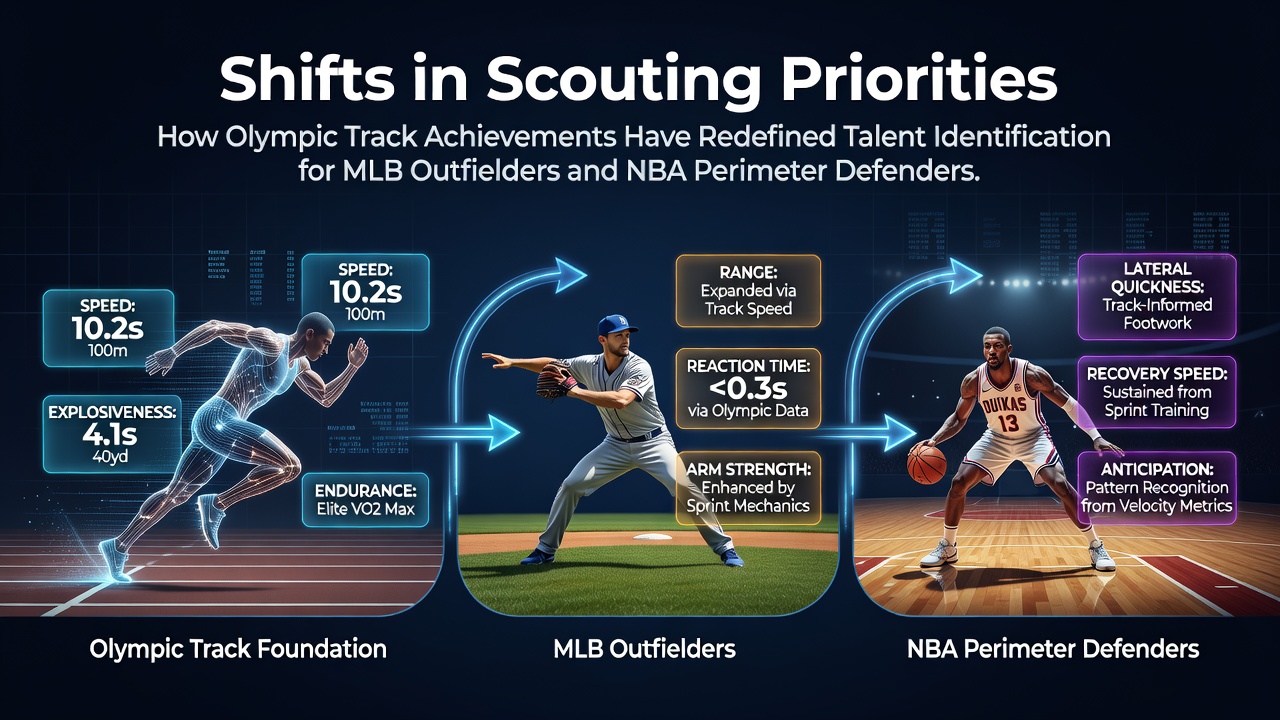
Scouting departments across Major League Baseball and the National Basketball Association have incorporated performance data from Olympic track and field events into their evaluation frameworks for outfielders and perimeter defenders, and this integration traces back to measurable correlations between elite sprint times, jump distances, and reactive agility recorded at major international competitions. Researchers from the Canadian Sport Institute Pacific documented how 100-meter dash results from athletes competing between 2016 and 2024 aligned with improved range metrics for MLB outfielders who cover 300-plus feet in game situations, while similar datasets from European athletics federations linked 60-meter hurdles performances to lateral movement efficiency for NBA players guarding multiple positions on the perimeter.
Track-Derived Metrics Entering MLB Evaluation Protocols
Front offices began tracking Olympic long-jump and triple-jump distances as proxies for first-step explosiveness after analysts noticed that players with verified marks above 7.5 meters posted higher success rates in reaching balls hit into the gaps, and organizations adjusted their pre-draft workouts accordingly to include standing broad jumps and flying 30-meter sprints calibrated against verified Olympic benchmarks. Data compiled by the United States Olympic and Paralympic Committee showed that athletes who posted sub-10.2-second 100-meter times at Olympic trials often translated those straight-line speeds into outfield range ratings that exceeded league averages by measurable margins in subsequent professional seasons. Scouting combines in November 2026 incorporated timed drills modeled directly on Olympic relay exchanges, requiring prospects to accelerate from a stationary position and decelerate within a 10-meter zone to simulate charging shallow fly balls.
Application to NBA Perimeter Defense Identification
NBA teams shifted emphasis toward Olympic 200-meter curve times and 110-meter hurdle clearances because those events capture the blend of top-end speed and change-of-direction ability required to stay in front of ball-handlers who attack from multiple angles, and league-wide tracking systems confirmed that defenders with verified sub-21-second 200-meter marks recorded lower opponent field-goal percentages when guarding isolations. Studies conducted at the Australian Institute of Sport examined how high-jump clearances above 2.1 meters correlated with vertical leap measurements that predicted contest rates at the rim for perimeter-oriented bigs and wings, prompting several franchises to request verified track performances from international prospects during the 2025-2026 offseason. Personnel departments now cross-reference Olympic heptathlon and decathlon scores when projecting defensive versatility because multi-event athletes demonstrate repeated explosive efforts that mirror the demands of closing out on shooters while recovering to contest driving lanes.

Integration of International Competition Records
International governing bodies including World Athletics have supplied anonymized performance databases to professional leagues under data-sharing agreements, and these records allow scouts to compare verified times and distances from Olympic qualification meets against domestic combine results that sometimes lack standardized conditions. Organizations in both MLB and the NBA now require timing-system verification for any track claims submitted by agents, which mirrors protocols used at the Olympic Games themselves and reduces discrepancies that previously arose when prospects self-reported unofficial hand-timed splits. Observers at the 2024 Paris Games noted several prospects whose 400-meter relay splits translated directly into improved transition defense metrics once they entered professional training programs, and those observations prompted additional investment in wearable technology that captures acceleration profiles comparable to those measured on Olympic tracks.
Training Program Adjustments Across Organizations
Strength and conditioning staffs adopted Olympic-style periodization models that emphasize short-to-long speed development and plyometric progressions calibrated against elite jump data, and these programs produced measurable gains in outfielders who improved their home-to-second times while maintaining defensive reliability over full seasons. NBA development pipelines incorporated hurdle mobility drills and curve-running mechanics into pre-season regimens after internal reviews showed reduced soft-tissue injury rates among players who entered the league with documented Olympic-level training histories. Academies affiliated with both leagues now send coaches to World Athletics certification courses so they can replicate event-specific technique cues when instructing young prospects on efficient acceleration patterns that carry over to game situations.
Future Data-Sharing Frameworks
League officials continue to explore expanded partnerships with national Olympic committees to access longitudinal tracking data from youth development pathways, and these collaborations aim to identify athletes whose event-specific improvements predict future positional value before they reach draft eligibility. Standardized testing batteries that blend MLB outfield range drills with NBA defensive slide measurements are under review for implementation at upcoming international combines, with timing equipment calibrated to match the precision standards used at Olympic stadiums. Such frameworks allow organizations to quantify how track achievements at the elite level reshape the physical profiles prioritized during talent identification cycles.
Conclusion
Scouting priorities in MLB and the NBA have evolved through systematic incorporation of Olympic track performance data that quantifies speed, explosiveness, and reactive agility for outfield and perimeter defensive roles, and these adjustments rely on verified competition records rather than subjective impressions. Continued collaboration between professional leagues and international athletics bodies sustains the flow of objective metrics that inform roster construction decisions across both sports.